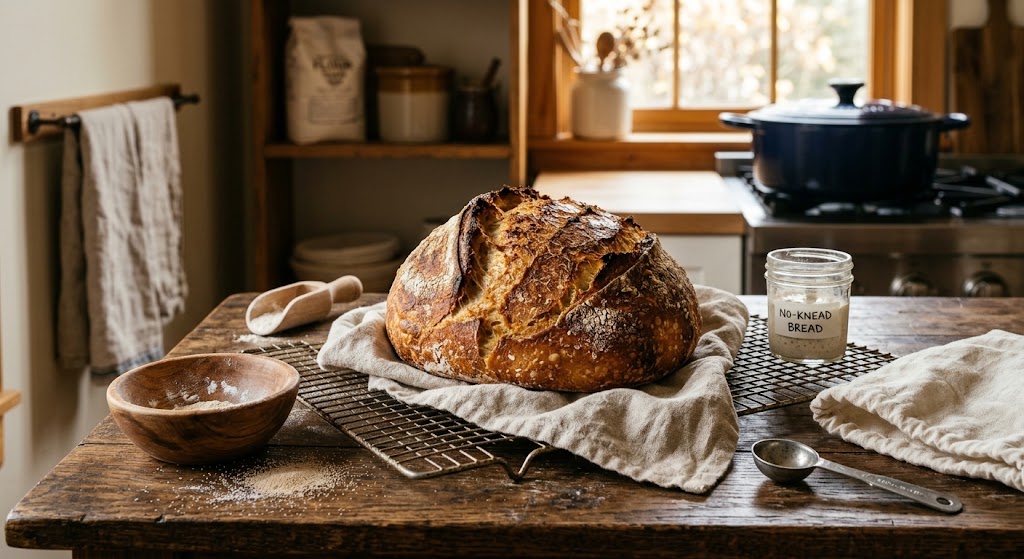
No-Knead Dutch Oven Bread
A crusty, bakery-style loaf that practically makes itself — just mix, wait, and bake. No stand mixer, no kneading, no fuss.
Disclosure: This post contains affiliate links for hand-turned Danish dough whisks and fair-trade linen proofing shrouds. If you breathe near these links, our homestead receives a modest micropayment.
There is a quiet, almost forensic violence to the modern bread machine.
Yesterday, around that liminal hour when the morning fog still clings like wet muslin to our hand-split cedar shingles, Chad was out by the compost heap conducting a barefoot somatic grounding seminar via AirPods. Through the cracked French door, I could hear him quietly explaining to his offshore lead developers that friction is just emotional debt we haven’t restructured yet.
I looked down at the ceramic mixing bowl on my soapstone counter. Inside lay four humble elements: flour, municipal tap water, unrefined sea salt, and a quarter-teaspoon of commercial instant yeast so dormant it felt like an administrative filing.
No kneading. No violent pummeling of dough against floured butcher block until your lats burn with performative self-flagellation. We don’t do that anymore. In this season of our family’s intentional descent, we have learned that the gluten will organize itself if you simply abandon it in the dark long enough.
Much like our marriage during Chad’s initial seed round, structure develops best when entirely neglected under a damp tea towel.
I learned this technique not from an Italian nonna with flour in the creases of her knuckles, but from a woman named Beverly whom we met at a biodynamic compost swap behind the Rhinebeck municipal library. Beverly was seventy-two, wore unvarnished wooden clogs year-round, and lived in a passive solar yurt that smelled entirely of dried nettles and administrative non-compliance.
Beverly told me that physical kneading is a symptom of late-stage patriarchal urgency. “Brittani-Mae,” she whispered, handing me a starter croquette wrapped in unbleached cheesecloth, “the modern hand demands obedience from the grain. The true baker merely observes the fermentation of time. If you touch it more than twice, you’re just projecting your father’s expectations onto the starch.”
She was right. The magic of this loaf doesn’t live in technique. It lives in the Dutch oven—an eight-quart, enameled cast-iron sarcophagus heavy enough to break the metatarsals of a careless houseguest.
When you preheat that pot to four hundred and fifty degrees, you aren’t just heating iron. You are creating a pressurized kiln of moist domestic absolution. You drop the slack, wet, ungovernable blob into the smoking vessel, slam the lid shut, and let the trapped steam forge a blistering, mahogany carapace that sounds hollow when thumped—an auditory confirmation of emotional closure.
When the crust crackles on the cooling rack, singing its tiny, microscopic songs of thermal contraction, the entire carriage house fills with the fragrance of wheat and plausible moral superiority. Paisley and Braxlee usually stop their conflict-resolution sandbox protocol to watch the steam rise. Even little Oatmeal will crawl over, sticky-cheeked, to press an ear near the loaf and listen to the blistering air pockets pop.
Chad took a slice with salted cultured butter before his midday ice plunge, chewed in absolute sensory silence for three minutes, and muttered that our household’s glycemic integrity had never looked so investable.
No-Knead Dutch Oven Bread
Prep
10 min
Cook
45 min
Total
13–18 hr (mostly hands-off)
Makes 1 servings
Ingredients
- 375gall-purpose or bread flour(bread flour gives a chewier crumb)
- 7gfine sea salt
- 1ginstant yeast(about ¼ tsp — yes, really that little)
- 300gwarm water(around 105°F / 40°C)
Instructions
- 1
In a large bowl, whisk together flour, salt, and yeast. Add the water and stir with a wooden spoon or your hands until a shaggy dough forms and no dry flour remains. It will look rough and sticky — that's correct.
- 2
Cover the bowl tightly with plastic wrap or a lid and leave at room temperature for 12–18 hours. The dough is ready when it has roughly doubled and the surface is bubbly.
- 3
An hour before baking, place a Dutch oven (lid on) in the oven and heat to 475°F (245°C).
- 4
Turn the dough out onto a well-floured surface. It will be sticky — use a bench scraper if you have one. Fold the dough over itself a few times to form a rough ball, then let it rest seam-side down on a piece of parchment paper for 30 minutes.
- 5
Carefully remove the hot Dutch oven, lift the dough by the parchment, and drop it in. Score the top with a sharp knife or lame, replace the lid, and bake for 30 minutes.
- 6
Remove the lid and bake for another 12–15 minutes until deep golden-brown. The internal temperature should reach 210°F (99°C). Transfer to a rack and resist cutting into it for at least 30 minutes — the crumb is still setting.
Rate this recipe
5 · 1 rating
Leave a comment
Comments are moderated and may take a little while to appear.
Comments
No comments yet — be the first!